
 Questions? Reach out!
 Events





High school exchange programme in Japan
Live and study like a Japanese teenager, becoming part of a local family and immersing yourself in the Japanese way of life.


Experience authentic life in the Land of the Rising Sun
Student exchange programme in Japan
No destination awakens the adventurer within a student quite like Japan. Its vastly different culture and social traits allow exchange students to really step into another world and out of their comfort zone.
Thousand-year old history, mouth-watering cuising, traditions, stunning landscapes, ideograms... generous, hospitable people who value harmony, respect and courtesy... and what about Japane's bustling cities, such as Tokyo and Osaka, capable of hiding pockets of calm and history amidst an hectic urban lifestyle?
Whether it’s a shrine or a tree glade, around every corner in Japan there is something to admire. In the Land of the Rising Sun, you will learn more about yourself as you experience a different way of life. Get ready for a challange that will gift you with the unexpected!

The charm of a culture that's so different to ours
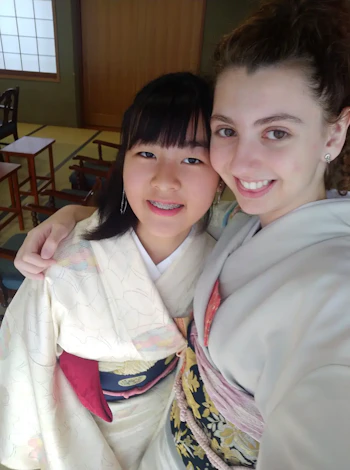
Kimono
This iconic garment is an enduring symbol of traditional Japanese culture. It's very common to see Japanese people wear a kimono for special ceremonies and significant occasion - don't let the opportunity pass you by! It's a great way to immerse yourself in the local culture.
What’s high school like in Japan?

Community spirit
Japanese schools foster community spirit and civic engagement through traditions like daily cleaning of shared spaces, students serving each other lunch, and other practices that cultivate humility and encourage a strong sense of belonging and ownership over the school environment.
Teamwork and leadership
During the academic year, Japanese high schools hold several student-led events, such as cultural festivals ('bunkasai') or sports festival ('undoukai'). Students collaborate to plan and execute these initiatives by themselves, developing skills like teamwork, accountability and initiative.
After-school activities
Japanese students are encouraged to join local club and associations: Japanese chess, martial arts, flower arrangement ('ikebana'), tea ceremony... This is a fantastic way for an exchange student to try different experiences and make new friends.
Classroom environment
A high degree of discipline and respect for authority, but also respect for the environment and kindness towards nature. Expect a totally different classroom environment, with customs and values deeply rooted in Shinto beliefs, and a particular focus on environment sustainability.
A country of incredible beauty. Let it surprise you!
Choose authenticity – trust WEP and prepare to be amazed.
On a Classic programme, you will experience the true Japan. You may be placed anywhere in the country, depending on the location of the host family who has chosen you to share this incredible adventure with.

Volunteer host family
Public school
Placement anywhere in Japan
10 months programme available
Your host family during your year abroad
Gain a second family – they can’t wait to welcome you into their lives!
Here is why:
In Japanese culture, having strong family bonds is considered essential for a prosperous, happy life. Your host family will do everything they can to integrate you in their life and culture - you'll soon feel like one of them!
Traditional Japanese families are made up of two parents, their children, and grandparents who often live nearby. Here's your chance to gain several new family members and build a relationship with each of them.
During your time in Japan, you'll have the opportunity to celebrate many traditional holidays with your host family: Japanese New Year, Sakura season, and many others. Experiencing local festivities and learning about traditions will be one of the most enriching parts of your exchange.

Your school in Japan
Find out more about your school experience in Japan
The Japanese education system consists of 6 years of primary schooling (from 6 to 12 years old) followed by 6 years of secondary education. Secondary schooling is further split into junior high schools (chūgakkō, 中学校) and senior high schools (kōtōgakko, 高等学校). Education is only compulsory from the age of 6 until the end of junior high school, at the age of 15, making the last three years of high school optional.
Japanese schools highly value respect and following the rules. Students must abide by a specific code of conduct which amongst other things, expects students to clean their classroom and wear their uniform correctly - in fact, uniforms are compulsory in all Japanese schools. In addition to showing respect to your teachers, you will also need to address your seniors (senpai, 先輩) in a respectful way, in light of their greater deal of experience, age, or rank.
The Japanese education system
During primary school, students only study the Japanese writing systems, including kanji (Chinese characters), hiragana, katakana and grammar. The rest of the time is devoted to play.
In secondary school, students have compulsory subjects including Japanese, literature, English, Japanese history, global histor, physical education, mathematics, social studies, science and art. In some schools, there are options to take instrumental music and singing classes as well.
School subjects
Secondary schooling in Japan goes for 6 years, of which the first 3 (junior high) are compulsory and the last 3 (senior high) are optional, and usually completed by academically-focused students who plan on continuing with university studies. The last 3 years of high school can be replaced by a year of vocational school (senmongakko 専門学校, which can also be taken at the end of senior high school), or by attending a College of Technology (kōsen 高専) for practical engineering and technical skills.
The full six years of secondary education include
*
chuuichi 中1 (12-13 years old)
*
chuuni 中2 (13-14 years old)
*
chuusan 中3 (14-15 years old)
*
kouichi 高1 (15-16 years old)
*
kouni 高2 (16-17 years old)
*
kousan 高3 (17-18 years old)
Japanese secondary school
After classes wrap up, you can stay at school a bit longer and join an extra-curricular activity, which are usually organised into clubs. You'll have plenty of choice - you may be able to join the school's athletics, volleyball, or kendo 剣道 (a martial art known as Japanese fencing) club, or perhaps try something like cinema, robotics or shōgi 将棋 (Japanese chess).
Some schools also host homework clubs divided by school subjects, where you'll be able to learn a new foreign language or perhaps focus on your Japanese.
Extra-curricular activities
The academic year in Japan starts in April and ends in March. Some schools divide the year into two semesters, while others prefer to break it up into three terms.
From July to August, students make the most of the summer holidays to relax, take trips to the beach or the mountains, or get ahead with their studies before the exam sessions. The winter holidays usually go from December 27th to early January, and are devoted to celebrating the Japanese New Year, which typically involves a visit to a shintō temple. Schools also close for a few days in the spring, and around national holidays or special events.
Public schools in Japan usually have classes five days a week, from Monday to Friday (although some have classes on Saturday, too). The timetable can vary dependong on the school, but classes usually start around 8:40 and end around 15:40, with six periods a day, typically lasting 50 minutes each. Before or after classes, students clean the classrooms in shifts. In addition to 10-minute breaks after each class, lunch break is usually an hour.
The school calendar
In Japan, marks are usually on a scale from 5 to 1, with 5 being the highest grade and 1 being the lowest.
The same system is used for school reports, whereas tests and exams throughout the year are usually graded using a percentage from 1 to 100.
Grading system

Stories from students and parents who have been there
Here are the testimonials of families who have chosen WEP for their exchange experience.
Going with WEP is best
Since 1988, a wide choice of destinations and comprehensive assistance before, during and after your overseas programme. WEP is the ideal partner for your big overseas adventure.
Like you, we also get to choose who we travel with: our schools, host families and overseas partner organisations are carefully selected.
We offer a custom-made insurance policy, specifically designed for our participants, and we have a solid network behind us.
Emergency assistance, overseas and in the UK, is available 7 days out of 7, 24 hours a day, 365 days a year.
Allowing all our participants to live their desired overseas experience is a mission, a challenge we're thrilled to accept.
FAQ
Your host family, local coordinator and your host organisation will provide you with support while you are overseas. WEP will remain in contact with the host organisation and your parents to coordinate and support your experience. In case of an emergency, both you and your family will be able to call an emergency phone number that is answered 24/7.
No. Even if you go on exchange to an English speaking destination, you will not be able to transfer work across to the UK school system. Students should expect to return home to the UK and start a new year of school having taken a gap year. Most applicants participate in a year program with WEP and return to school with the year below on their return. If you participate in a shorter program, your school might be willing to allow you to catch up with missed work so that you can continue in your same school year. All these decisions are made by your school so it is important that you talk with them before applying for the program.
Our partners have different rules regarding your language proficiency - some ask that you have between 1 and 2 years of experience with their language, while others (such as Brazil, Argentina, Denmark, Finland and Norway) do not require you to have learnt their language before departing on exchange.
If you want to go to a country where English is not the first language, you must be committed to learning the language and studying as much as possible before you depart - the more you know on arrival, the easier the transition will be. It wouldn’t be acceptable for you to arrive on exchange with no knowledge of the language, as you would struggle to establish yourself on the program.
Of course, there are English-speaking destinations available if you are not interested in learning another language.
No, it's the host families who choose the student they wish to invite into their home. Based on the documents you will submit as part of your WEP application, one lucky family will choose to open their home and hearts to you, which is why there is no avenue for students participating in a Classic exchange program to choose a specific location.
It may be possible to live with an overseas family that you already know (excluding relatives of the student). However, the family will have to be screened and approved, prepared and supported by our partner organisation in the same manner as any other host family. School enrolment must also be available.
Host families come in all shapes and sizes. There is no set idea of what a family will look like, so it's very important that you have an open mind. Some families have children of your age or younger; some have children who have grown up and moved away; others have not had children. Some are single parent or single person families. Some families have same-sex parents.
We ask that a host family provides a safe and caring environment for a young person to live in. Whatever your family looks like, they will welcome you as part of their family.
Most of our families are based in suburban or rural areas. It is very rare that a family is based in a large city.
In the USA, you can pay an additional fee to request a region or state of your choice. Placement in these areas is not guaranteed but you can state a preference. You only pay the fee if you are placed in the area you have requested.
Alternatively, on our Preferred programs in the USA, Canada and Australia, you can choose where exactly you will live as you can choose your school or school district.
Families in every destination are selected by a similar process:
Home interview -a staff member/representative of our partner organisation visits the family at home. They discuss what is involved in hosting and ensure they have the right motivation for hosting. They also assess the home for suitability and comfort.
References – friends/colleagues of family members are contacted and asked about the family’s ability to host and care for a young person.
Police check – all adult members of the home must complete a criminal background check.
NB: in Japan it is not possible for a criminal check to be secured due to the stringent bureaucracy preventing adults from getting a check of this nature. Most families are known by the school and the school plays a role in recruiting families.
Our partner organisations aim to notify your placement to you at least one month before departure. We hope that it will be no later than this, but, on occasion, the information does arrive later. Placement details could arrive a few days after you lodge your application or several months later. Whatever the situation, you have to be patient and be ready to contact your host family as soon as you receive the placement information sheet.
No. In most destinations your visa will not allow you to work while on the program. We also discourage students from working as it can prevent you from participating fully in other activities while on exchange. Students can volunteer if they wish.
No. Visits from family and friends are definitely not allowed during the exchange program. Your parents can plan to collect you at the end of the program from your host family home, but otherwise they cannot visit. If they do wish to collect you, they must notify WEP so that we can arrange your flight home for the correct date and arrange an extension of your insurance policy where needed. Please note that any additional fees for these changes are not included in the program fee.
Independent travel is not permissible while on exchange. However, you will be able to travel with your host family, school, host organisation and other community groups such as sporting teams or scouts. Again, the foremost aim of the program is educational, and your priority for any holiday periods must be your host family, who will be investing a lot of time, energy and money into this experience - simply in return for your frienship and positive contribution to their household.
Most of our partner organisations offer additional trips or tours that students can join to see more of their host country. The relevant information will be shared with your prior to departure or just after arrival. The cost of the trips or tours is not included in your program fee, so if you wish to join them you should budget for the extra expenses.

More questions?