
 Questions? Reach out!
 Events





High school exchange programme
in New Zealand
Immerse yourself in the New Zealand culture and way of life, joining a kiwi family and studying at a local secondary school.


Experience authentic life in Aotearoa, the Land of the Long White Cloud
Student exchange programme in New Zealand
New Zealand is a land of incredible natural beauty, between suggestive mountains, stunning coasts, unique wildlife and untouched national parks. The Land of the Long White Cloud is home to a welcoming community of friendly people, nicknamed kiwis (after New Zealand's beloved flightless bird) and incorporating several different cultures: 70% of New Zealanders is of European descent, 18% Maori, 17% Asian and 9% other Pacific Islands, in addition to other minorities.
Thanks to a deep connection with nature, and a respectful approach to the various ethnic groups that make up its society, New Zealand will offer you an educational experience that goes beyong the traditional confines of a school building.
You will grow, mature and unlock your true potential in a supportive environment that values sustainability, discovery and harmony across communities. This experience will transform you into a conscious global citizen and open the door to a more holistic outlook on life.

New Zealand is forever
Excellence in school
New Zealand schools offer a balanced approach to learning, where academic excellence is just as important as student wellbeing: hands-on activities, sports, creative projects... you'll be encouraged to develop a comprehensive suite of skills that are useful in real life, in a supportive and engaging context.
What’s high school like in New Zealand?

A growth opportunity
New Zealand's education system focuses on personalised learning: each student builds their own program and schedule, based on their interests and talents. This flexible choice enhances autonomy, self-accountability and the drive to take initiative on one's own future.
Support and encouragement
Classes are small, students have a direct relationship with teachers, and there's plenty of support available for students to start building a solid foundation for the future. In New Zealand schools, both academic development and personal advancement are huge priorities.
A bilingual society
English and Maori are the two official languages and you will experience both on a daily basis. The coexistence of these two cultures will enhance your educational experience, promoting understanding and respect towards different ways of seeing the world.
An eye to the environment
Learning doesn't have to be confined to the classroom. Students are engaged in practical projects linked to environmental sustainability and the impact of humans on this planet, allowing them to gain experience on the field and become responsible citizens.
A stunning country, lots of choice. Which programme is right for you?
Choose authenticity – trust WEP and prepare to be amazed
On a Classic programme, you will experience the most authentic side of New Zealand. You may be placed anywhere in the country, depending on the location of the host family who has chosen you to share this incredible adventure with.

Volunteer host family (minimal reimbursement)
Public school
Placement anywhere in New Zealand
5, 9 or 11-month programmes available
Live the dream –
create a tailor-made programme
On a Flex programme to New Zealand, it's up to you to choose where you'll live, which sports you’d like to try and which subjects you’d like to study. In short, you create an experience that's tailored to you.
Homestay family with reimbursement
Choice of school, with tuition fees included in programme fee
Placement in your chosen location and school
5, 9 or 11-month programmes available
Your host family during your year abroad
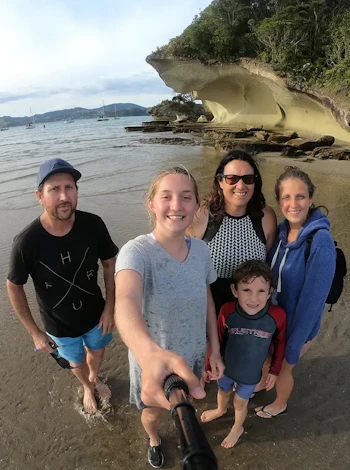
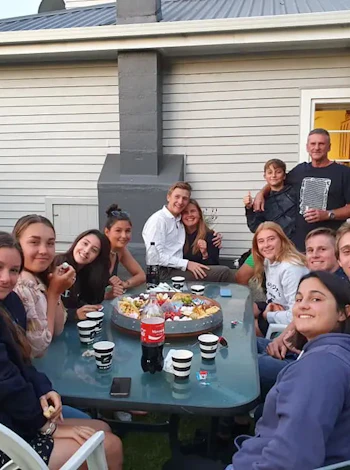
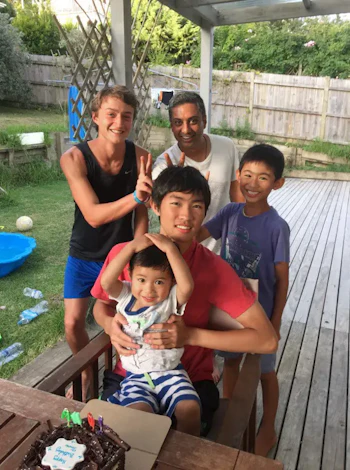
Gain a second family – they can’t wait to welcome you into their lives!
Here is why:
According to the Maori concept of Manaakitanga, each of us should offer the best we have to others, both in terms of practical care and hospitality - food, lodging, etc. - and in terms of emotional and spiritual support. Collective responsibility, reciprocity and the importance of nurturing positive relationships is part of New Zealand's DNA. You'll feel part of the family in no time!
Family living means taking part in local celebrations and family customs. Whether it's preparing a traditional hangi for someone's birthday, celebrating Waitangi Day, or paying your respect on ANZAC Day, you'll be fully enveloped in New Zealand's inclusive culture.
A deep connection with the land is part of New Zealand lifestyle. Envision helping your host grandad with his vegetable garden, taking a walk on the beach on a Saturday morning, having picnics in the park or hopping on a kayak with your host mum: with your kiwi family, you'll learn about new ways to enjoy the outdoors.
Family (Whānau) reunions and community events are vital to promote a sense of belonging and the idea of reciprocal support. New Zealand families highly value any time spent with relatives and friends, whether it's a special occasion or simply a relaxed opportunity to be together.

Your school in New Zealand
Find out more about your school experience in Aotearoa
In New Zealand, the education system is made up of 13 year levels. Children begin primary education at the age of 5 or 6 with Year 1 (age 5-6), until Year 8 (age 13-14).
Secondary education goes from Year 9 to Year 13. Many students graduate at the age of 17 or 18.
Schooling is compulsory from age 6 to 16.
The New Zealand education system
Every year, studetns have a number of core subjects which are compulsory: mathematics, English, PE, social sciences, environmental studies.
In addition, students can choose 4 or 5 optional subjects according to their interests. You may get the opportunity to learn about new topics and discover new passions: fashion design, cooking, environmental studies, technology, Maori language and culture...
Foreign languages are also widely taught in New Zealand schools: Japanese, Italian, German, Spanish and many more.
School subjects
High school in New Zealand is organised into five year levels:
9th grade: 13-14 years old
10th grade: 14-15 years old
11th grade: 15-16 years old
12th grade: 16-17 years old
13th grade: 17-18 years old
To graduate high school and access university, students must attain the National Certificate of Educational Achievement (NCEA) - Level 3. Students generally start with Level 1 in Year 11, and progress through levels by achieving a number of credits, working through to Level 3 in Year 13.
High school in New Zealand
After school, New Zealand students can take part in various extra-curricular activities. You'll be able to play a sport o join a club, which is a great idea to ease your integration and bond with local students.
You may get to try your hand at rugby, golf, rowing, swimming, tennis ad many other popular sports. Alternatively, you could take a dance, drama or music course - every school tends to have remarkable infrastructure such as sports centre, libraries, auditoriums, music rooms, computer rooms and green spaces to facilitate activities and help students develop their and creativity.
Extra-curricular activities
The school year in New Zealand begins in late January and ends in December. The year is divided into 4 terms, each concluded by 2 weeks of holidays. After Term 4, schools close for the summer holidays which go for about 6 weeks.
- 1° term: late January to early April
- 2° term: late April to early July
- 3° term: late July to mid-September
- 4° term: early October to mid-December
Schools also close on specific national holidays̀ such as:
- Waitangi Day – 6th February: to celebrate the signing of the Waitangi Treaty.
- Anzac Day – 25th April: to honour Australian and New Zealand war veterans.
- King’s Birthday – first Monday of June: to celebrate the birthday of the Monarch, like most Commonwealth countries do.
- Labour Day – fourth Monday of October, to celebrate all workers.
School calendar and holidays
Marks in New Zealand can change slightly from school to school, but throughout the year student work is usually assessed on a scale from A to F. A+ is the best possible mark, F is the worst, and C is the minimum passing grade.
When it comes to NCEA levels, instead, students must gain certain credits at that level or above using a four-grade scale: Not Achieved (N), Achieved (A), Merit (M) and Excellence (E).
Grading system

Stories from students and parents who have been there
Here are the testimonials of families who have chosen WEP for their exchange experience.
Going with WEP is best
Since 1988, a wide choice of destinations and comprehensive assistance before, during and after your overseas programme. WEP is the ideal partner for your big overseas adventure.
Like you, we also get to choose who we travel with: our schools, host families and overseas partner organisations are carefully selected.
We offer a custom-made insurance policy, specifically designed for our participants, and we have a solid network behind us.
Emergency assistance, overseas and in the UK, is available 7 days out of 7, 24 hours a day, 365 days a year.
Allowing all our participants to live their desired overseas experience is a mission, a challenge we're thrilled to accept.
FAQ
Your host family, local coordinator and your host organisation will provide you with support while you are overseas. WEP will remain in contact with the host organisation and your parents to coordinate and support your experience. In case of an emergency, both you and your family will be able to call an emergency phone number that is answered 24/7.
No. Even if you go on exchange to an English speaking destination, you will not be able to transfer work across to the UK school system. Students should expect to return home to the UK and start a new year of school having taken a gap year. Most applicants participate in a year program with WEP and return to school with the year below on their return. If you participate in a shorter program, your school might be willing to allow you to catch up with missed work so that you can continue in your same school year. All these decisions are made by your school so it is important that you talk with them before applying for the program.
Our partners have different rules regarding your language proficiency - some ask that you have between 1 and 2 years of experience with their language, while others (such as Brazil, Argentina, Denmark, Finland and Norway) do not require you to have learnt their language before departing on exchange.
If you want to go to a country where English is not the first language, you must be committed to learning the language and studying as much as possible before you depart - the more you know on arrival, the easier the transition will be. It wouldn’t be acceptable for you to arrive on exchange with no knowledge of the language, as you would struggle to establish yourself on the program.
Of course, there are English-speaking destinations available if you are not interested in learning another language.
No, it's the host families who choose the student they wish to invite into their home. Based on the documents you will submit as part of your WEP application, one lucky family will choose to open their home and hearts to you, which is why there is no avenue for students participating in a Classic exchange program to choose a specific location.
It may be possible to live with an overseas family that you already know (excluding relatives of the student). However, the family will have to be screened and approved, prepared and supported by our partner organisation in the same manner as any other host family. School enrolment must also be available.
Host families come in all shapes and sizes. There is no set idea of what a family will look like, so it's very important that you have an open mind. Some families have children of your age or younger; some have children who have grown up and moved away; others have not had children. Some are single parent or single person families. Some families have same-sex parents.
We ask that a host family provides a safe and caring environment for a young person to live in. Whatever your family looks like, they will welcome you as part of their family.
Most of our families are based in suburban or rural areas. It is very rare that a family is based in a large city.
In the USA, you can pay an additional fee to request a region or state of your choice. Placement in these areas is not guaranteed but you can state a preference. You only pay the fee if you are placed in the area you have requested.
Alternatively, on our Preferred programs in the USA, Canada and Australia, you can choose where exactly you will live as you can choose your school or school district.
Families in every destination are selected by a similar process:
Home interview -a staff member/representative of our partner organisation visits the family at home. They discuss what is involved in hosting and ensure they have the right motivation for hosting. They also assess the home for suitability and comfort.
References – friends/colleagues of family members are contacted and asked about the family’s ability to host and care for a young person.
Police check – all adult members of the home must complete a criminal background check.
NB: in Japan it is not possible for a criminal check to be secured due to the stringent bureaucracy preventing adults from getting a check of this nature. Most families are known by the school and the school plays a role in recruiting families.
Our partner organisations aim to notify your placement to you at least one month before departure. We hope that it will be no later than this, but, on occasion, the information does arrive later. Placement details could arrive a few days after you lodge your application or several months later. Whatever the situation, you have to be patient and be ready to contact your host family as soon as you receive the placement information sheet.
No. In most destinations your visa will not allow you to work while on the program. We also discourage students from working as it can prevent you from participating fully in other activities while on exchange. Students can volunteer if they wish.
No. Visits from family and friends are definitely not allowed during the exchange program. Your parents can plan to collect you at the end of the program from your host family home, but otherwise they cannot visit. If they do wish to collect you, they must notify WEP so that we can arrange your flight home for the correct date and arrange an extension of your insurance policy where needed. Please note that any additional fees for these changes are not included in the program fee.
Independent travel is not permissible while on exchange. However, you will be able to travel with your host family, school, host organisation and other community groups such as sporting teams or scouts. Again, the foremost aim of the program is educational, and your priority for any holiday periods must be your host family, who will be investing a lot of time, energy and money into this experience - simply in return for your frienship and positive contribution to their household.
Most of our partner organisations offer additional trips or tours that students can join to see more of their host country. The relevant information will be shared with your prior to departure or just after arrival. The cost of the trips or tours is not included in your program fee, so if you wish to join them you should budget for the extra expenses.

More questions?