
 Questions? Reach out!
 Events





High school exchange programme
in Spain
Immerse yourself in the Spanish way of life, living with a host family and studying at a local secondary school.


Experience authentic Spain – the joy of living day to day
Student exchange programme in Spain
Going on exchange to Spain means immersing yourself in a warm, hospitable and passionate way of life. Spanish people are known to be eager to share their rich culture and traditions with whomever visits their country - prepare to be blown away by their contagious enthusiasm!
Living and studying in Spain will allow you to learn Spanish, one of the most commonly spoken languages in the world. You will also discover a colourful culture where family, friends and good food play a central role.
With its beautiful coastline, beautiful cities exuding history, fascinating traditions and mouth-watering gastronomy, Spain's vibrant lifestyle is sure to broaden your horizons! ¡Vamos!

Spain: so much to discover
Cuisine
You will have plenty of opportunities to try the most celebrated Spanish dishes: think tapas, tortillas, paella… but also an array of lesser-known specialties, which are just as delicious.
What's high school like in Spain?

A different education style
Education in Spain is interpreted in a holistic sense, aiming not only at academic excellence but also at the personal development of each and every student. Extracurricular activities, sports, artistic and cultural pursuits - your vision of education is sure to evolve!
Personalised programme
In addition to mandatory subjects, you will be able to personalise your programme by choosing some of your courses. Whether you’d like to explore how a familiar subject is taught in Spain, or you wish to learn new things, make the most of it!
Informal relationships
Spanish teachers are approachable and attentive. They are there to support you, help you make the most out of your Spanish school experience, and answer your questions. Don’t hesitate to go to them for help or advice.
Early knock-off
Classes in Spain generally start around 8:30 am and finish by 2:00 pm. This means there is no lunch break - you will have lunch at home, or out with your friends. Afternoons will be free to dedicate to a sport, hobby or activity of your choosing.
Let life in España blow you away during your exchange.
Choose authenticity – trust WEP and prepare to be amazed.
On a Classic programme, you will experience the most authentic side of Spain. You may be placed anywhere in the country, depending on the location of the host family who has chosen you to share this incredible adventure with.

Volunteer host family
Public school
Placement anywhere in Spain
2, 4, 5 or 10-month programmes available
Your host family during your year abroad
Gain a second family – they can’t wait to welcome you into their lives!
Here is why:
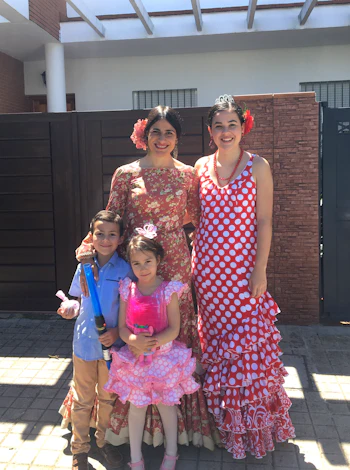
Spaniards are known to be friendly and welcoming: you will feel part of the family in no time. They will be keen to share their culture with you and make you feel at home.
Spanish people enjoy human contact; they love to chat and laugh, spending lots of time with family and friends. Sharing meals and watching football together – exploding with joy at every score and every win – are favourite past-times.
Dinnertime is a great moment to be together. Spanish families love to chat over a good meal, in a lively and warm atmosphere. Try cooking something for your host family - they will appreciate it.
Your Spanish family will be there to support you. Whether it’s giving you a hand with homework, helping you choose an after-school activity or simply having a good time with you, you can count on them!

Your school in Spain
Find out more about your school experience in Spain
Education in Spain formally begins at the age of 6 with primary school, which lasts 6 years. Afterwards, students move on to secondary schooling: the first 4 years are compulsory, and can be followed by 2 more non-compulsory years which are useful for university preparation (bachillerato). At the end of this period, those who wish to continue studying can sit the bachillerato exam to access university or other higher education options.
The Spanish education system
While in Spain, you will study compulsory subjects including Spanish, physical education and one foreign language.
You will also be able to choose elective subjects from different areas of interest, such as science and technology (including advanced maths and physics), art (drama or music), humanities (including literature or philosophy) or economic and social sciences, featuring applied maths and business studies.
Subjects in Spain
In Spanish upper secondary school (Bachillerato) students can really immerse themselves in their field of interest and explore a variety of interesting subjects, choosing from four different streams:
* Art
* Business and social studies
* Literature
* Scientific and technologic
Spanish secondary school
Participation in after-school activities in Spain happens through sport clubs and social/recreational centres available in the community, outside of the school environment. There is usually a wide range of choice, and it’s a fantastic way to expand your circle of friendships!
Extra-curricular activities
The school year in Spain begins in September and ends in late June. School holiday periods include a week or two around Christmas and Easter, and a longer summer break.
Schools are also closed on regional (varying from one area to the next) and national holidays, including:
- New Year's Day: January 1st, including the tradition of eating 12 grapes at midnight
- Epiphany: January 6th, a special celebration for children
- Holy Thursday (except in Catalonia) and Good Friday: in April, a great opportunity to share a good meal with the whole family
- Labour Day: May 1st, a well-deserved break for all workers
- Assumption of Mary: August 15th, a religious holiday shared by many Latin Catholics
- National Day of Spain: October 12th, a patriotic celebration with processions and aerial parades
- All Saints' Day: November 1st, a moment of family remembrance and commemoration
- Constitution Day: December 6th, celebrating Spanish identity
- Immaculate Conception of Mary: December 8th, religious holiday shared by all Hispanic countries
- Christmas Day: December 25th, with family celebrations and good food
The Spanish school calendar
The grading system in Spain is based on a 0-10 scale, where 0 is the lowest mark and 10 the highest. 5 is the minimum mark to pass.
Grading system in Spain
Stories from students and parents who have been there
Here are the testimonials of families who have chosen WEP for their exchange experience.
Going with WEP is best
Since 1988, a wide choice of destinations and comprehensive assistance before, during and after your overseas programme. WEP is the ideal partner for your big overseas adventure.
Like you, we also get to choose who we travel with: our schools, host families and overseas partner organisations are carefully selected.
We offer a custom-made insurance policy, specifically designed for our participants, and we have a solid network behind us.
Emergency assistance, overseas and in the UK, is available 7 days out of 7, 24 hours a day, 365 days a year.
Allowing all our participants to live their desired overseas experience is a mission, a challenge we're thrilled to accept.
FAQ
Your host family, local coordinator and your host organisation will provide you with support while you are overseas. WEP will remain in contact with the host organisation and your parents to coordinate and support your experience. In case of an emergency, both you and your family will be able to call an emergency phone number that is answered 24/7.
No. Even if you go on exchange to an English speaking destination, you will not be able to transfer work across to the UK school system. Students should expect to return home to the UK and start a new year of school having taken a gap year. Most applicants participate in a year program with WEP and return to school with the year below on their return. If you participate in a shorter program, your school might be willing to allow you to catch up with missed work so that you can continue in your same school year. All these decisions are made by your school so it is important that you talk with them before applying for the program.
Our partners have different rules regarding your language proficiency - some ask that you have between 1 and 2 years of experience with their language, while others (such as Brazil, Argentina, Denmark, Finland and Norway) do not require you to have learnt their language before departing on exchange.
If you want to go to a country where English is not the first language, you must be committed to learning the language and studying as much as possible before you depart - the more you know on arrival, the easier the transition will be. It wouldn’t be acceptable for you to arrive on exchange with no knowledge of the language, as you would struggle to establish yourself on the program.
Of course, there are English-speaking destinations available if you are not interested in learning another language.
No, it's the host families who choose the student they wish to invite into their home. Based on the documents you will submit as part of your WEP application, one lucky family will choose to open their home and hearts to you, which is why there is no avenue for students participating in a Classic exchange program to choose a specific location.
It may be possible to live with an overseas family that you already know (excluding relatives of the student). However, the family will have to be screened and approved, prepared and supported by our partner organisation in the same manner as any other host family. School enrolment must also be available.
Host families come in all shapes and sizes. There is no set idea of what a family will look like, so it's very important that you have an open mind. Some families have children of your age or younger; some have children who have grown up and moved away; others have not had children. Some are single parent or single person families. Some families have same-sex parents.
We ask that a host family provides a safe and caring environment for a young person to live in. Whatever your family looks like, they will welcome you as part of their family.
Most of our families are based in suburban or rural areas. It is very rare that a family is based in a large city.
In the USA, you can pay an additional fee to request a region or state of your choice. Placement in these areas is not guaranteed but you can state a preference. You only pay the fee if you are placed in the area you have requested.
Alternatively, on our Preferred programs in the USA, Canada and Australia, you can choose where exactly you will live as you can choose your school or school district.
Families in every destination are selected by a similar process:
Home interview -a staff member/representative of our partner organisation visits the family at home. They discuss what is involved in hosting and ensure they have the right motivation for hosting. They also assess the home for suitability and comfort.
References – friends/colleagues of family members are contacted and asked about the family’s ability to host and care for a young person.
Police check – all adult members of the home must complete a criminal background check.
NB: in Japan it is not possible for a criminal check to be secured due to the stringent bureaucracy preventing adults from getting a check of this nature. Most families are known by the school and the school plays a role in recruiting families.
Our partner organisations aim to notify your placement to you at least one month before departure. We hope that it will be no later than this, but, on occasion, the information does arrive later. Placement details could arrive a few days after you lodge your application or several months later. Whatever the situation, you have to be patient and be ready to contact your host family as soon as you receive the placement information sheet.
No. In most destinations your visa will not allow you to work while on the program. We also discourage students from working as it can prevent you from participating fully in other activities while on exchange. Students can volunteer if they wish.
No. Visits from family and friends are definitely not allowed during the exchange program. Your parents can plan to collect you at the end of the program from your host family home, but otherwise they cannot visit. If they do wish to collect you, they must notify WEP so that we can arrange your flight home for the correct date and arrange an extension of your insurance policy where needed. Please note that any additional fees for these changes are not included in the program fee.
Independent travel is not permissible while on exchange. However, you will be able to travel with your host family, school, host organisation and other community groups such as sporting teams or scouts. Again, the foremost aim of the program is educational, and your priority for any holiday periods must be your host family, who will be investing a lot of time, energy and money into this experience - simply in return for your frienship and positive contribution to their household.
Most of our partner organisations offer additional trips or tours that students can join to see more of their host country. The relevant information will be shared with your prior to departure or just after arrival. The cost of the trips or tours is not included in your program fee, so if you wish to join them you should budget for the extra expenses.

More questions?